How can sterile API manufacturers improve decolorization and endotoxin reduction without sacrificing product yield? This case study explains how Darlly developed an optimized activated carbon depth filtration solution for a Chinese manufacturer of penem antibiotic APIs.
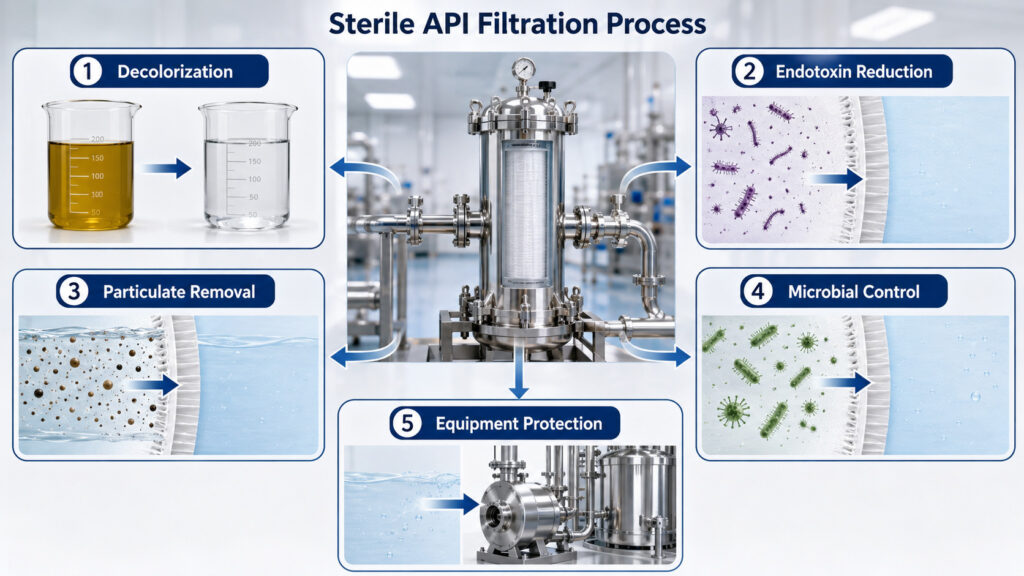
Sterile API production must follow strict GMP requirements, with filtration supporting decolorization, endotoxin reduction, particulate removal, microbial control, and equipment protection. In penem antibiotic manufacturing, however, excessive adsorption of the target product can reduce recovery and create significant economic losses.
The customer required a depth-stack filtration solution that could support FDA, EU, and Chinese regulatory expectations while delivering stable performance under actual production conditions. The filtration system needed to balance four priorities:
Darlly’s engineering team analyzed the chemical characteristics of the penem antibiotic process and conducted compatibility, integrity, and performance testing. Based on the results, an optimized activated carbon depth filter sheet with high carbon content was selected.
The filter sheet provided strong decolorization and endotoxin-reduction performance while maintaining an extremely low adsorption rate for the target product. This helped improve API purity and product recovery while protecting the economic value of each production batch.
The project delivered stable product quality, improved yield, and reliable purification performance. It also helped Darlly establish more comprehensive testing specifications for activated carbon filter sheets and depth filter stacks, supporting faster product selection and consistent quality control for future pharmaceutical applications.
For sterile API manufacturers, the right filtration solution helps protect product purity, maintain production stability, reduce process uncertainty, and maximize product value.